Kyoto temples
nobody visits
Kyoto has around 1,600 temples and roughly ten of them are crowded. These are the ones five minutes away from the queue, what they cost, and which famous thing each one replaces.
Start with the Daitoku-ji subtemples at ¥300–400 each — Ryogen-in, Zuiho-in and Daisen-in — zen gardens of the very first rank, on a Saturday, with nobody in them, and thousand-year-old aburi-mochi at Imamiya-jinja next door for about ¥600. Then Sanjusangendo, ¥600, 1,001 gilded statues and no queue because photography is banned. Then Nanzen-ji (grounds free, brick aqueduct) and Kennin-ji (¥800, twin dragons on the ceiling, in the middle of Gion and still empty). None of them need booking. All of them take cash at the gate.
Sixteen temples with no queue
- 01
The Daitoku-ji subtemples, and aburi-mochi after
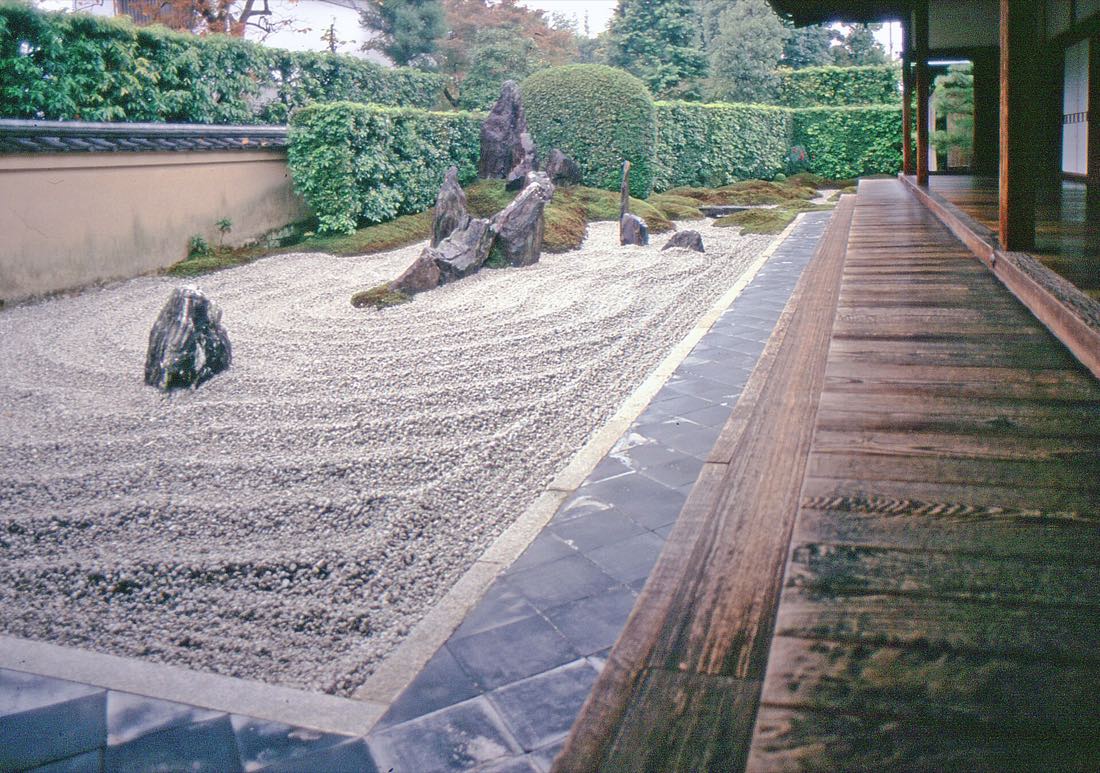
A walled compound of two dozen subtemples of which three or four open to the public: Ryogen-in, Zuiho-in and Daisen-in, ¥300–400 apiece. Daisen-in's dry garden is one of the most important in Japan and you will share it with about six people. Koto-in has been closed since the COVID period — check before you go rather than walking there for it. Finish at Imamiya-jinja next door, where two shops facing each other across the approach have been grilling skewered aburi-mochi over charcoal for a thousand years, about ¥600 a plate. Replaces: a second pass at Kinkaku-ji.
- 02
Sanjusangendo
One thousand and one gilded Kannon figures ranked in a 120-metre hall, each individually carved, flanked by 28 guardian deities that genuinely startle. Photography is banned inside, which is the whole reason it stays calm — nobody queues for a shot and nobody lingers for one. It appears on more "best thing we did" lists than any other Kyoto sight and it is almost never busy. Replaces: nothing. Just go.
- 03
Nanzen-ji and the brick aqueduct
The head temple of its Rinzai branch, with free grounds you can wander at will and an enormous Sanmon gate you can climb for ¥600 with a real view over the trees. Running straight through the complex is a red-brick Meiji aqueduct still carrying water — an entirely unexpected sight in a zen temple and the best photograph in northern Higashiyama. Replaces: queuing at Ginkaku-ji.
- 04
Kennin-ji
Kyoto's oldest zen temple sits at the bottom of Hanamikoji, in the middle of the most photographed district in Japan, and stays quiet all day. Twin dragons cover the ceiling of the Hatto hall, there is a circle-triangle-square garden, and — unusually — photography is permitted. Fifty metres from a street where people queue to stand. Replaces: the second hour in Gion.
- 05
Tenryu-ji
The main temple of Arashiyama and the thing visitors most often say they should have given more time to. A 700-year-old pond garden that has kept its original design, framed by the Arashiyama hills. Routing trick: leave by the north gate and you step straight into the quiet end of the bamboo grove. Replaces: half an hour of shuffling through the grove at noon.
- 06
Okochi Sanso Villa
A silent film star's hillside garden and house, ¥1,000 including a bowl of matcha and a sweet at the end, fifty metres from the mobbed bamboo path and reliably near-empty. It has its own bamboo, a circuit walk with views over the Hozu gorge, and a teahouse. Repeatedly called the best ¥1,000 in Arashiyama, and it is. Replaces: the rickshaw.
- 07
Higashi and Nishi Honganji
Two of the largest wooden buildings in the world, free, ten minutes' walk from Kyoto Station, and usually near-empty. The scale of Higashi Honganji's Goei-do does not survive photography — you have to stand in it. Look for the coiled ropes woven from human hair, donated by women during the 19th-century rebuild when hemp ropes kept breaking. Replaces: Kyoto Tower.
- 08
To-ji and the Kobo-san market
Japan's tallest wooden pagoda at 55 metres, a hall of carved Buddhist figures arranged as a three-dimensional mandala, and a fifteen-minute walk from Kyoto Station. ¥500. On the 21st of every month the grounds fill with over a thousand stalls for the Kobo-san flea market, free to walk, and it is one of the best markets in Japan. Replaces: the second temple of your last day.
- 09
Shoren-in
Five minutes' walk from a Gion that is heaving, and reliably calm. Enormous camphor trees at the entrance, a pond garden by a celebrated designer, and tatami rooms where you are allowed to sit down and stay a while — which is rarer than it should be. It also runs one of the better night illuminations in season. Replaces: the Kiyomizu approach at 14:00.
- 10
Honen-in
Eight minutes south of Ginkaku-ji along the Philosopher's Path, up a short flight of steps that almost everyone walks past. Free. A thatched gate, two mounds of raked white sand you walk between, and a moss courtyard. It takes twenty minutes and it is the best free thing on the whole path. Replaces: the queue at Ginkaku-ji's gate.
- 11
Otagi Nenbutsu-ji
Twelve hundred stone rakan statues carved by amateur sculptors in the 1980s, now thickly mossed, each one different and a great many of them funny — one holds a tennis racket, another a camera. It is at the far north end of Sagano, well beyond where coach groups turn around, and it is one of the most purely enjoyable places in Kyoto. Replaces: a third garden.
- 12
Gio-ji
A tiny thatched hut and a maple-shaded moss carpet, ¥300, twenty minutes. It is the cheapest genuinely beautiful thing in Kyoto and it is best in drizzle, when the moss goes luminous. Pair it with Otagi Nenbutsu-ji and Adashino Nenbutsu-ji (¥1,000 from April 2026) for a northern Sagano morning with almost nobody in it. Replaces: Saiho-ji, which needs an application and costs many times more.
- 13
Shisen-do, Manshu-in and Enko-ji
Three temples in the northeastern foothills, reached from Ichijoji station on the Eizan line. Shisen-do is a poet's retreat with a shishi-odoshi bamboo water clacker; Enko-ji has a moss and maple garden that rivals anything in Higashiyama in November at a fraction of the crowd. Then eat: Ichijoji is Kyoto's ramen street, fifteen shops in a few hundred metres. Replaces: Eikan-do in autumn.
- 14
Takaragaike Park
Not a temple, and included because it makes the point better than any temple can. A lake, woodland paths and wild deer at the northern end of the Karasuma subway, free, twenty minutes from the centre, and with essentially no foreign visitors in it at any hour of any day. Replaces: the belief that Kyoto is full.
- 15
The Fushimi sake district
Three kilometres south of Fushimi Inari at Chushojima: canals, white-walled warehouses, around 40 working breweries and almost no Western visitors. The Gekkeikan Okura museum is ¥600 including a tasting, and several breweries run their own tasting rooms. It pairs perfectly with a dawn start at the shrine. Replaces: an afternoon fighting for space in Gion.
- 16
Ishibei-koji
A short curving stone lane behind Kodai-ji, walled in dark wood and tile, widely described as the most beautiful street in Kyoto — and off every coach route, three minutes from Ninenzaka. It takes ten minutes and costs nothing. Go at dusk. It is a residential lane, so keep your voice down and do not photograph doorways. Replaces: Sannenzaka at 13:00.
Crowded thing, emptier thing, five minutes away
Every pair below is walkable in under fifteen minutes. In most of them the quieter option is also cheaper.
| Instead of this | Price | Go here | Price | Verdict |
|---|---|---|---|---|
| Kinkaku-ji at 13:00 | ¥500 | Daitoku-ji subtemples — Ryogen-in, Zuiho-in, Daisen-in | ¥300–400 each | WORTH IT |
| Ginkaku-ji's entrance queue | ¥500 | Honen-in, 8 min south on the Philosopher's Path | Free | WORTH IT |
| The bamboo grove at noon | Free | Okochi Sanso — its own bamboo, garden and matcha | ¥1,000 | WORTH IT |
| Sannenzaka at 13:00 | Free | Ishibei-koji, three minutes west and empty | Free | WORTH IT |
| A second hour on Hanamikoji | Free | Kennin-ji at the bottom of the same street | ¥800 | WORTH IT |
| Kyoto Tower | ~¥900 | Higashi and Nishi Honganji, 10 minutes away | Free | WORTH IT |
| Eikan-do in late November | ~¥1,000 | Enko-ji and Shisen-do, Eizan line to Ichijoji | ¥500–600 | WORTH IT |
| Tofuku-ji's autumn bridge | ~¥1,000 | Nanzen-ji's grounds and aqueduct, free all year | Free | WORTH IT |
| Nishiki Market at 11:30 | Free | Imamiya-jinja's aburi-mochi shops, 1,000 years old | ~¥600 | WORTH IT |
| Saiho-ji, the moss temple | Application + ¥3,000+ | Gio-ji, ¥300, and better in drizzle | ¥300 | WORTH IT |
None of the right-hand column needs a booking, a lottery or an application. All of them take cash at the gate. Timing for the left-hand column is on the crowd clock.
Getting to the quiet ones
The problem with this list is not access, it is distance — these sit in four different corners of the city. Temple gates take cash at the door and never sell out — a tour is worth paying for because of the guiding and the hour, not to skip a queue that does not exist.
Underrated Kyoto temples FAQ
Which temples in Kyoto are not crowded?
The Daitoku-ji subtemples (¥300–400 each), Sanjusangendo (¥600), Nanzen-ji (free grounds), Kennin-ji (¥800, and it is in Gion), To-ji (¥500), Shoren-in (¥600), Honen-in (free), Otagi Nenbutsu-ji (¥500) and both Honganji temples (free). All are walk-in, all take cash, and none of them require a booking of any kind.
What is the most underrated temple in Kyoto?
Sanjusangendo, at ¥600. A 120-metre hall of 1,001 gilded Kannon statues, and it stays uncrowded for one structural reason: photography is banned inside, so nobody queues for a shot. Kennin-ji is a close second — Kyoto's oldest zen temple, ¥800, sitting at the bottom of Hanamikoji in the busiest district in the city and still quiet.
Is Koto-in at Daitoku-ji open?
It has been closed to the public since the COVID period and has not reliably reopened. Check the current position before you make the trip for it specifically. Ryogen-in, Zuiho-in and Daisen-in are the ones you can normally count on, at ¥300–400 each, and they are the reason to go anyway.
Where can I see a moss garden in Kyoto without applying months ahead?
Gio-ji in northern Sagano, ¥300, walk in, twenty minutes. Saiho-ji, the famous moss temple, requires a written application and costs many times more. Sanzen-in in Ohara (¥700, an hour out on bus 17 for ¥600) is the other strong option. All three are better in drizzle than in sun.
Which quiet temple is best in autumn?
Enko-ji and Shisen-do in the northeastern foothills, ¥500–600 each, reached from Ichijoji on the Eizan line. They peak at the same time as Eikan-do and Tofuku-ji, cost half as much, and carry a fraction of the crowd. Colour starts around 10–15 November and peaks 20 November to 5 December, drifting later in warm years.
Do any Kyoto temples require advance booking?
Very few. Katsura Imperial Villa, Shugakuin Imperial Villa and Saiho-ji require applications, and the Nintendo Museum runs a lottery. Everything else on this page and almost everything in the city takes cash at the gate on the day. No Kyoto temple has adopted the dual pricing that Himeji Castle introduced in March 2026.
How do I find quiet temples myself while I'm there?
Two rules. Walk in the opposite direction to the coach park, which usually buys you 200 metres of empty street. And enter the temples that charge ¥300–400 rather than the ones that charge ¥500–1,300 — the price roughly tracks fame, not quality, and the cheap ones are frequently better. See also the crowd clock for the ten places to avoid at midday.