Is Nishiki Market
worth it?
Nishiki is a 390-metre covered arcade that is actively debated as Kyoto's newest tourist trap, and the debate is fair. The product mix has drifted hard toward wagyu skewers, strawberry daifuku and tako-tamago photo bait at ¥500–1,500 a piece, and locals have largely ceded the aisle. Go for 30 minutes before 10:00 or after 15:00, buy knives, pickles, tamagoyaki or yuba, and eat your actual meal somewhere else. If you want the market Kyoto people still shop in, go to Demachi Masugata instead.
What hour to go
There is no single opening time — stalls raise their shutters between 9:00 and 10:00 and close between 17:00 and 18:00, individually. The crowd curve, however, is completely predictable, and it is driven by tour-group scheduling rather than by lunch.
Shutters going up one at a time. Maybe half the stalls are trading, but the aisle is walkable and shopkeepers will actually talk to you. The best hour for buying knives or pickles.
Why Nishiki gets called a tourist trap now
Because the accusation is largely true, and it is a recent change. Nishiki was a working fish and vegetable market for four centuries. What it sells today is mostly things a visitor eats standing up in ten minutes.
The economics are simple. A stall can sell a ¥1,500 wagyu skewer to a hundred people a day, or vegetables to a chef for a margin measured in yen. The skewers won. Walk the arcade now and you will pass strawberry daifuku, tako-tamago (a baby octopus stuffed with a quail egg — the photograph everyone takes), soft-serve, mochi and "wagyu" of unverified grade at ¥1,500–3,000 a stick. Some of it is fine. Almost none of it is why Nishiki was famous.
Eating while walking is officially discouraged. Signage has asked visitors to eat at the stall where they bought since 2019, and most stalls now set aside a small standing area. This is not a suggestion the shopkeepers are relaxed about — the arcade is 3 to 4 metres wide and a crowd eating on the move stops it dead.
Locals have largely ceded the aisle. You will still see Kyoto shoppers at the pickle, tofu, knife and dried-goods shops, mostly early. You will not see them buying skewers at noon.
None of which makes it worthless. It makes it a 30-minute shopping errand rather than a food destination — and it is genuinely covered, which puts it on the short list for a rainy day.
What is actually worth buying here
Five things justify the walk. Everything else you can get better and cheaper 200 metres away.
Aritsugu knives (established 1560, at the Gokomachi crossing) — the famous one. They will sharpen and hand-engrave your name in the blade for free while you wait. Be aware the reputation is now mixed: recent buyers report tourist-facing pricing, long queues and rushed service, and Kyoto cooks increasingly point people to Shigeharu or to Sakai-forged makers instead. If you want a knife rather than a souvenir of buying a knife, compare before you commit.
Tamagoyaki at Miki Keiran — rolled omelette made continuously in front of you, hot, from about ¥200 a skewer for the small ones. The one item on the arcade that is both photogenic and a genuine Kyoto staple.
Kumiage yuba — the soft skin lifted off the top of heated soy milk, eaten with a little soy and ginger. Kyoto's signature ingredient and hard to find fresh anywhere else at this price.
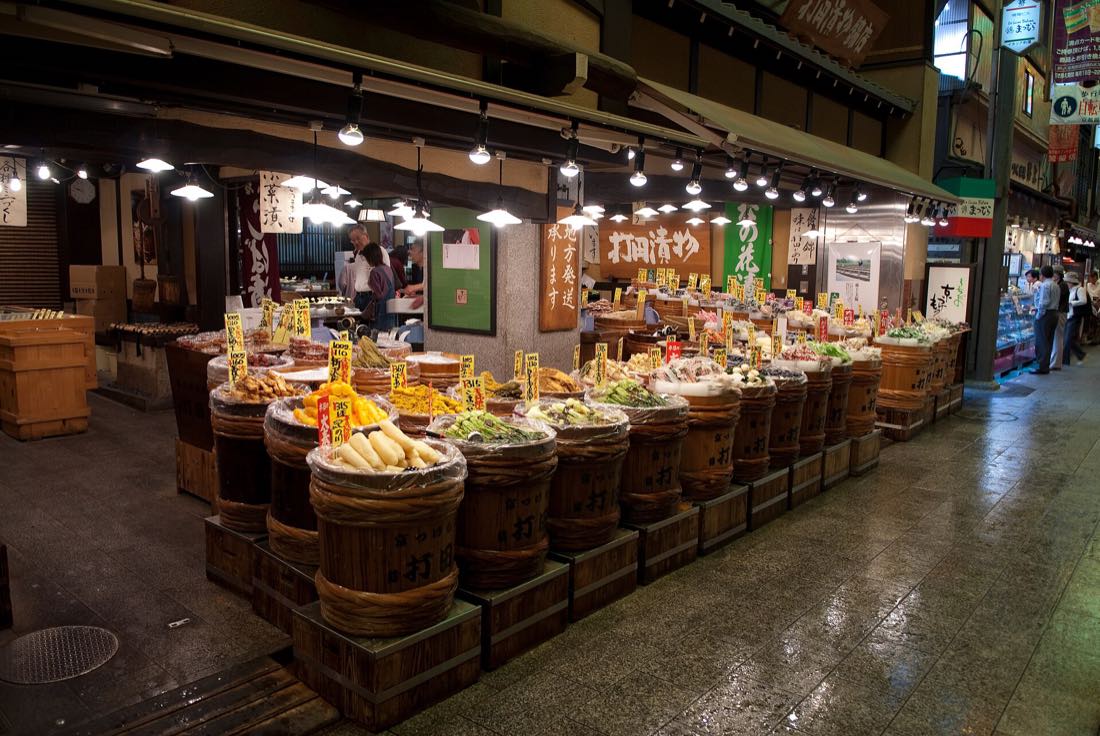
Tsukemono — the pickle shops are the last unambiguously local businesses in the arcade. Vacuum-packed senmaizuke and shibazuke travel home fine and cost ¥600–1,200 a pack.
Soy-milk donuts — cheap, hot, made from tofu-shop byproduct, and the one bit of walking-food here that is unmistakably Kyoto rather than imported from an Instagram feed.
Three markets that are better than Nishiki
If what you actually want is a Japanese food market rather than the famous one, all three of these are better, and none of them will cost you an hour of queueing.
Demachi Masugata shotengai — the real people's Nishiki, in the north of the city near Demachiyanagi station. A short, scruffy, entirely local arcade of butchers, fishmongers, greengrocers and prepared-food shops, plus Demachi Futaba, whose mame-mochi has a queue of Kyoto residents out the door most afternoons — the one queue in this city that is worth joining. It also sits at the start of the Eizan line, so it pairs with Kurama or Ichijoji.
Sanjo-kai shotengai — 800 metres of covered arcade in the west of the centre, almost no tourists, prices at local levels, and a good cross-section of everyday Kyoto food shopping.
The depachika at Takashimaya and Daimaru — the honest recommendation. Two basement food halls on Shijo, five minutes from Nishiki, selling superior versions of the same pickles, sweets, tofu and prepared food with no crowd, air conditioning, free samples, and 20–50% markdowns after about 19:00. If you only have time for one, this is the better one.
For a guided version that gets you into stalls you would walk past, the food tours below combine Nishiki with Gion or Pontocho in the evening, which is exactly the right time to be in both.
The practical bit
Is Nishiki Market for you?
Tours that use Nishiki properly
Nishiki is free and needs no ticket. What a guide buys you is entry to stalls that do not deal with tourists, the Japanese to order at them, and — crucially — a route that leaves the arcade before it fills.
Nishiki Market FAQ
Is Nishiki Market a tourist trap?
Largely, yes — and that is now the mainstream view rather than a contrarian one. The product mix has drifted to ¥500–1,500 skewers, daifuku and photo food, and locals mostly shop elsewhere. It is still worth 30 minutes before 10:00 or after 15:00 for knives, pickles, tamagoyaki and yuba.
What time does Nishiki Market open?
There is no single opening time. Stalls raise shutters between 9:00 and 10:00 and close between 17:00 and 18:00, each on its own schedule. Arrive at 9:30 and roughly half the arcade is trading with almost nobody in it — the best trade-off of the day.
Can you eat while walking in Nishiki Market?
You are asked not to. Signage since 2019 requests that you eat at the stall where you bought, and most stalls provide a small standing area for exactly that. The arcade is only 3 to 4 metres wide and a crowd eating on the move blocks it completely.
How much money should I bring to Nishiki Market?
¥3,000–5,000 per person covers a proper graze. Individual items run ¥500–1,500, pickles ¥600–1,200 a pack. Bring cash — a lot of stalls still do not take cards — and small notes rather than a ¥10,000 bill.
Is Aritsugu still worth buying a knife from?
It depends what you want. Established 1560, free hand engraving, and the name carries weight. But recent buyers report tourist-level pricing, long waits and hurried service, and Kyoto cooks often point people to Shigeharu or to Sakai-forged makers instead. Handle a few before you spend ¥20,000.
What is the best alternative to Nishiki Market?
Demachi Masugata arcade in the north of the city — a genuinely local shotengai, home to Demachi Futaba's mame-mochi queue. For quality with zero crowd, the Takashimaya and Daimaru depachika on Shijo sell better versions of the same things, with markdowns after 19:00.
How long do you need at Nishiki Market?
Thirty to forty-five minutes end to end. It is 390 metres long. Anyone budgeting two hours is planning to queue, and the queue is the part worth avoiding.
Continue planning
Eat it with a local
Kyoto food tours & tastings — guided street-food crawls and cooking classes with vetted operators, most with free cancellation.