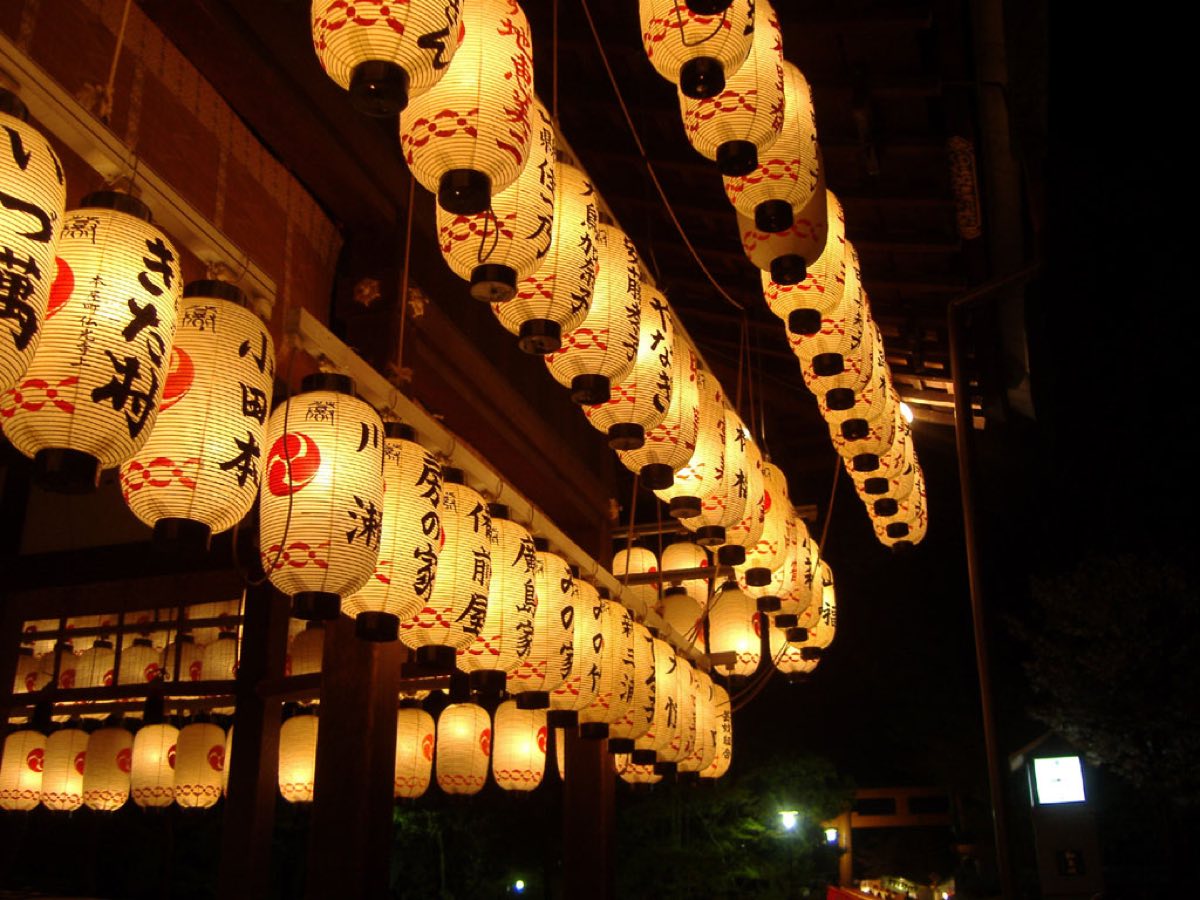
Kyoto at night:
what's actually open
The city gets called dead after dark by people who went back to the hotel at seven. Gion only becomes Gion at dusk, Fushimi Inari is lit and empty at 21:00, and Pontocho runs to 1am.
"Kyoto dies at 6pm" is the most repeated wrong thing about the city. It is true that there is no Tokyo-style all-night scene and that most places shut between midnight and 1am. It is not true that there is nothing to do. Gion only becomes itself at dusk, Fushimi Inari is free, lit and genuinely empty past 21:00, Pontocho's counter bars run late, and from spring to early December there are temple illuminations most evenings. What you should not plan around: both Hanatoro festivals are discontinued, and half the internet has not noticed.
Ten things to do in Kyoto after dark
- 01
Gion and Hanamikoji at dusk
The one window when geiko and maiko move between engagements is roughly 17:45, and the lanterns come on just before. Three rules, all enforced: the private alleys off Hanamikoji have been closed to visitors since April 2024 with signposted fines up to ¥10,000; photographing geiko or maiko without consent has been banned since 2019; and you never follow, touch or block anyone. Stay on the main public street and the Shirakawa canal lane, which is quieter and prettier.
- 02
Fushimi Inari after dark
Free, open all night, and lit along the lower trail. Past 21:00 you can walk for ten minutes under the gates without meeting anybody — which is impossible at any daylight hour. Bring a phone light for the upper loop above Yotsutsuji, which is unlit, and check the last JR train from Inari, which runs to roughly midnight.
- 03
Seasonal temple illuminations
These are the 2025 windows — re-check the current year before you plan around them. Kiyomizu-dera runs special night openings in spring, 9–16 August and mid-November to early December, for about ¥400–500 on top of the ¥500 daytime entry. To-ji charged ¥1,000 from 1 November to 14 December. Eikan-do ran about ¥700 from 15 November to 10 December and is the best maple lighting in the city. Dates shift by a week or two each year with the foliage.
- 04
Kodai-ji's projection-mapped garden
The one illumination that is not just floodlights. Kodai-ji projects moving imagery onto its bamboo grove and dry garden and runs late — to around 22:00, which is unusually late for a Kyoto temple. It is eight minutes' walk from Kiyomizu-dera and a short hop from Ishibei-koji, so the three make one strong evening.
- 05
Pontocho and the Kamo riverbank
A lantern-lit alley barely wide enough for two people, running five blocks between Shijo and Sanjo. Walking it is free and it is one of the best night walks in Japan. Eating on it is where you pay a premium — go one street back, upstairs, or into a basement. From May to September restaurants open kawayuka decks out over the river, which is the single most pleasant way to eat in a Kyoto summer.
- 06
Kyoto Station's light shows and the free Skyway
The 171-step Grand Staircase runs LED light shows in the evening, the Skyway crosses the roof on the 11th floor, and the Sky Garden is open above that. All free, all indoors, all a two-minute walk from your last train. It is the obvious late-arrival evening and nobody ever plans it.
- 07
Kiyamachi — the student izakaya strip
One street west of Pontocho and a completely different city: neon, canal, cheap izakaya and a student crowd. Beer runs ¥500–700 and food is priced to match. Expect otoshi, a ¥300–800 seating charge that comes with a small dish — it is a convention, not a scam, and there is no tipping anywhere in Japan.
- 08
Cocktails on Pontocho and around Kiyamachi
Pontocho's bars are 6 to 10 seats behind a sliding door. The north end is the classy half and the south end is the touristy half — walk up rather than down. Bee's Knees and L'Escamoteur are the two names people give first for serious cocktails, and Kyoto Brewing Co. is the answer for craft beer. Nearly everything closes between midnight and 1am.
- 09
Cormorant fishing in Arashiyama
A thousand-year-old fishing method performed from wooden boats by torchlight on the Oi River, roughly 1 July to 23 September, about an hour, ¥2,300–3,500. It is genuinely atmospheric and it is also a short, slow spectacle that some people find underwhelming — book it if you are already in Arashiyama for the evening, not as a special trip.
- 10
Late ramen at Ichijoji
Fifteen ramen shops on one street near Ichijoji station on the Eizan line, and the closest thing Kyoto has to a cult food destination. Most are cash only, most have a ticket machine at the door, and the good ones have a queue even late. Kyoto ramen is dark and back-fatty rather than delicate — that is the local style, not a mistake.
Both Hanatoro festivals are discontinued
This needs saying loudly, because a large amount of published Kyoto content still lists them as annual events and people are planning trips around festivals that no longer exist.
Arashiyama Hanatoro was held for the last time in December 2021. Higashiyama Hanatoro ended in spring 2022. Neither has returned, and neither is scheduled to. If a blog, guidebook or itinerary tells you to visit in mid-March for the Higashiyama lantern festival, it has not been updated in four years.
What replaced them is smaller and scattered: individual temples running their own paid night openings rather than one district-wide free event. That is worse for a stroll and better for a photograph, because the lit temple is now a ticketed space rather than a lantern-lined street with 100,000 people on it.
The practical upshot: plan your night around a specific temple's illumination, not around a festival. Kiyomizu-dera, Kodai-ji, To-ji, Eikan-do and Shoren-in all run night openings in the November–early December window, each with its own dates and its own ticket. Confirm the current year's dates on each temple's own site before you book anything around them, because the foliage moves and the dates move with it.
One genuine city-wide night event does survive and it is the biggest of all: Gozan no Okuribi on 16 August, when five enormous character-shaped bonfires are lit on the hills around the city from 20:00, burning for about twenty minutes. It is free, it is visible from the Kamo riverbank, and hotels for that night book out far ahead.
What actually stays open, and until when
Kyoto's night scene is real but small, and it is shaped by the fact that this is a city of about 1.4 million people with a university population and an early-rising service industry.
Kiyamachi is the loud, cheap end: a canal-side strip one street west of Pontocho, heavy on students, izakaya beer at ¥500–700, and food priced for people who are not on holiday. Expect an otoshi seating charge of ¥300–800 that arrives as a small dish. It is not a cover charge scam and it is not negotiable. Tipping does not exist anywhere in Japan.
Pontocho is the narrow, expensive, beautiful end: six-to-ten-seat counter bars behind sliding doors, cocktails at ¥1,200–2,000. The north half, toward Sanjo, is where the serious bars are; the south half toward Shijo has drifted touristy with photo menus outside. Walk north.
The names people give first are Bee's Knees and L'Escamoteur for cocktails, both downtown and both small enough that you may wait. Kyoto Brewing Co. is the craft beer answer, out toward Minami-ku with a taproom rather than a bar.
Closing time is the real constraint. Most bars call last orders between midnight and 1am and there is no Tokyo-style all-night infrastructure to fall back on. Trains stop around midnight, taxis are plentiful and metered, and a cross-city fare is usually ¥1,500–2,500. Plan the last train or plan the taxi — do not plan on a 3am bar.
Dinner without a reservation is solved by the department store restaurant floors at Takashimaya and Daimaru on Shijo, which run to about 21:00 or 22:00, take walk-ins, and are far better than that description suggests. Full options on the food guide.
The night bookings worth making
Two of these buy you a guide at an hour you would otherwise skip, and the third is the cross-check. Temple gates take cash at the door and never sell out — a tour is worth paying for because of the guiding and the hour, not to skip a queue that does not exist.
Kyoto at night FAQ
Does Kyoto really shut down at 6pm?
No, but it does close earlier than Tokyo or Osaka. Temples shut between 16:30 and 18:00, most restaurants take last orders around 21:00, and bars close between midnight and 1am. What is open after dark is Gion, Fushimi Inari, Pontocho, Kiyamachi, Kyoto Station and — from November to early December — several ticketed temple illuminations.
What time can you see a geisha in Gion?
Between roughly 17:30 and 18:30, with about 17:45 the most likely moment, as geiko and maiko walk between engagements. You may get eight seconds. Stay on the main public street, do not follow anyone, and do not photograph them without consent — that has been banned since 2019, and the private alleys have been closed to visitors since April 2024 with fines up to ¥10,000.
Is Fushimi Inari open at night?
Yes — it is free, has no gate and never closes. Past 21:00 you can walk for ten minutes without seeing another person, and the lower trail is lit. Bring a phone light for the unlit stretches above Yotsutsuji, and check the last JR train from Inari station, which runs to roughly midnight.
Is the Higashiyama Hanatoro still on?
No. Higashiyama Hanatoro ended in spring 2022 and Arashiyama Hanatoro ended in December 2021. Neither has returned. A lot of published content still lists them. What runs instead are individual ticketed temple illuminations at Kiyomizu-dera, Kodai-ji, To-ji, Eikan-do and Shoren-in, mostly from mid-November to early December.
When are the Kyoto autumn illuminations?
Mostly mid-November to around 10 December, tracking the foliage, which peaks 20 November to 5 December and has been drifting later in warm years. In 2025 To-ji ran 1 November to 14 December at ¥1,000 and Eikan-do ran 15 November to 10 December at about ¥700. Treat those as indicative and confirm the current year on each temple's own site.
Where should I go drinking in Kyoto?
Kiyamachi for cheap izakaya and beer at ¥500–700, Pontocho's north end for six-seat cocktail bars at ¥1,200–2,000 a drink, and Kyoto Brewing Co. for craft beer. Expect an otoshi seating charge of ¥300–800 at izakaya, which is normal. Nothing tips, and nearly everything closes between midnight and 1am.
What's there to do in Kyoto in the evening with no bookings?
Walk Hanamikoji at 17:45, then Ishibei-koji, then Yasaka Shrine's lanterns, then down Pontocho and along the Kamo riverbank. That is two hours, costs nothing, and is the best free evening in the city. If you would rather be alone, take the JR to Inari and walk the torii at 21:00.