Kyoto in
3 days
Three full days is the community minimum and it works — as long as you cluster by district and start early. This is the route, with the trains, the opening times and the two mornings that decide whether you love the city.
Day 1: Southern Higashiyama, starting at Kiyomizu-dera's 6:00 opening and ending in Gion after dark. Day 2: the Arashiyama bamboo grove before 8:30, then the Randen tram to Kinkaku-ji and Ryoan-ji. Day 3: Fushimi Inari at dawn, then south to Uji or Nara. Two to three paid sights a day, one district at a time, an afternoon rest built in. Entry fees total around ¥4,000 per person.
The two rules that make Kyoto work
Almost every disappointed Kyoto trip report breaks one of two rules. Neither is about which temple you pick.
Rule one: cluster by district. Kinkaku-ji and Ginkaku-ji sit on opposite sides of the city, and doing both in a day means an hour on a packed bus. Each day below stays in one area and walks it.
Rule two: be first or be last. Every hour outside 9:00–17:00 is worth roughly double. Two of these three days start before 7:00. If that sounds unpleasant, it is — for about four minutes, until you are standing alone under ten thousand torii gates.
One quieter rule: avoid the city buses. Kyoto abolished the tourist bus day-pass in 2023 specifically to push visitors onto trains, and locals describe the 205 at peak as sardine hell. Everything below is reachable by train, tram, bike or a 15-minute walk.
Southern Higashiyama, dawn to lantern-light
Kiyomizu-dera, at opening
The single best crowd hack in Kyoto: this temple opens at 6:00 while every other headline sight opens at 8:30 or 9:00. ¥500. You will share the famous veranda with a dozen people instead of a thousand. Walk up from the Kiyomizu-michi stop, or take a ¥1,200 taxi from downtown.
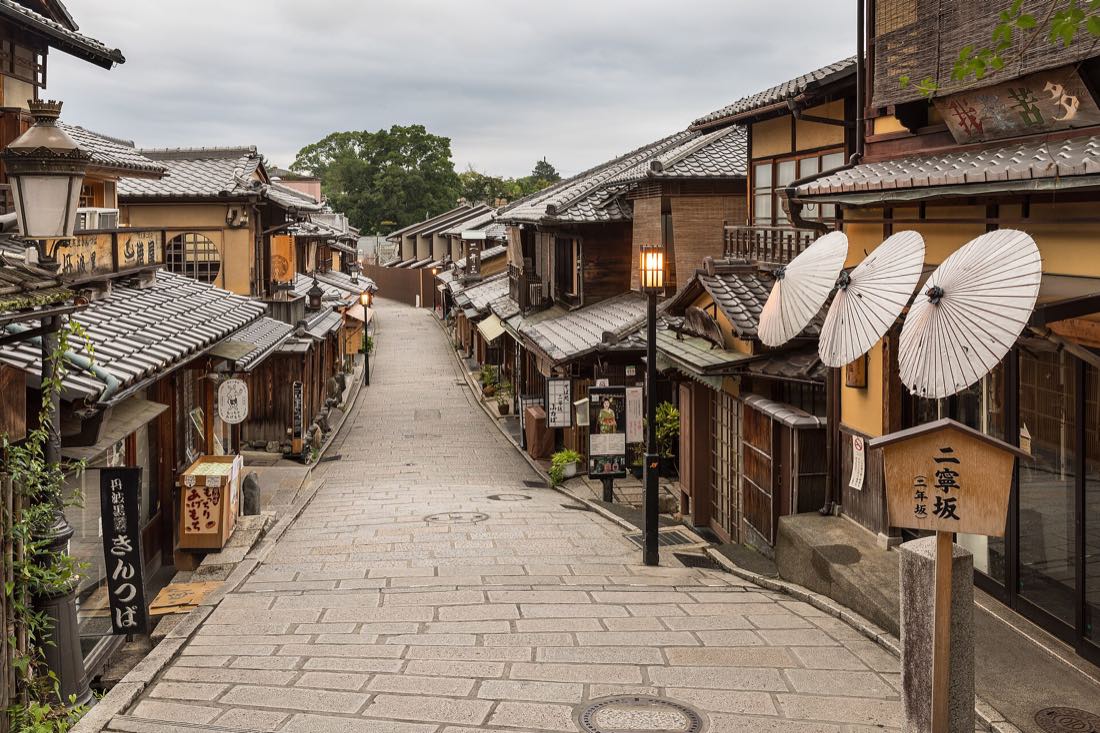
Sannenzaka and Ninenzaka, empty
The preserved stone lanes below the temple are the postcard, and before 9:00 they are yours. Shops open around 10:00, so this is a walking-and-photographs stretch rather than a shopping one.
Kodai-ji and Ishibei-koji
¥600. A raked garden, a small crowd-free bamboo path, and beside it the stone lane widely called the most beautiful in Kyoto. Twenty minutes, no queue.
Kennin-ji — Gion's hiding-in-plain-sight zen HQ
¥800. Kyoto's oldest zen temple sits at the bottom of Hanamikoji and stays shockingly uncrowded. Twin dragons on the ceiling, a circle-triangle-square garden, and photography permitted, which is unusual and worth it.
Lunch downtown, then rest
Cross the Kamo River into Pontocho or the Nishiki area. Then go back to the hotel for two hours — standard advice in Kyoto, not laziness. The afternoon has the worst light and the worst crowds.
Sanjusangendo
¥600, last entry 16:30, so check the season's hours before you commit. One thousand and one gilded Kannon statues in a 120-metre hall. Photography is banned inside, which is exactly why it stays uncrowded and why it tops so many 'best thing we did' lists.
Hanamikoji at dusk
The one window when geiko and maiko move between engagements. Watch the rules: private alleys off Hanamikoji have been closed to tourists since 2024 with signposted fines up to ¥10,000, and photographing geiko without consent has been banned since 2019. Stay on the main street and never follow anyone.
Dinner on Pontocho — one street back
The alley itself is a beautiful free walk. For eating, go one street parallel, or upstairs, or into a basement. The department-store restaurant floors at Takashimaya and Daimaru are the reliable no-reservation fallback.
Arashiyama early, then the northwest by tram
Bamboo grove, before it becomes a queue
JR Saga-Arashiyama is 15 minutes and ¥240 from Kyoto Station. The grove is a five-minute corridor, not a forest — that is the honest description — and before 8:30 it is magical, while at noon it is rickshaws and selfie sticks. Free, always open.
Tenryu-ji garden
¥500 for the garden, ¥300 more for the buildings, opens 8:30. The 700-year-old pond garden is the thing visitors say they should have given more time. Routing hack: leave by the north gate and you walk straight into the quieter end of the bamboo grove.
Okochi Sanso Villa
¥1,000 including matcha and a sweet, and repeatedly called the best ¥1,000 in Arashiyama. A film star's hillside garden, fifty metres from the mobbed grove, and near-empty.
Monkey Park Iwatayama, or the river
¥800 cash, a genuinely steep 20-minute climb, and at the top you enter a caged hut to feed wild macaques through the mesh for ¥100. The best free panorama of Kyoto is up there. If the climb is not for you, walk the Togetsukyo bridge instead.
Randen tram to the northwest
The little Randen tram (¥250 flat, or ¥700 all day) runs from Arashiyama toward the northwest temple axis. It is the crowd-free routing most itineraries miss, and it beats the 205 bus by every measure.
Kinkaku-ji, the Golden Pavilion
¥500, closes 17:00. Be honest about what this is: you cannot go inside, the path is one-way, and 30–45 minutes covers it. It is still the most photographed building in Japan, and a snow morning here is a lottery win.
Ryoan-ji's rock garden
¥600. Fifteen rocks in raked gravel. Profound if you sit for twenty minutes; a gravel rectangle with a crowd if you photograph it and leave. Your call which visit you have.
Back downtown for dinner
Karasuma subway from Kitaoji, or the Randen back to Shijo-Omiya. Ramen at Ichijoji if you want the cult version — fifteen shops on one street, cash only, expect to queue at the good ones.
The southern rail axis — Fushimi Inari and beyond
Fushimi Inari at first light
JR Nara Line, 5 minutes, ¥150. Free, open 24 hours. Walk to the Yotsutsuji intersection — 30 to 40 minutes up, where the view opens and 80% of the crowd has already turned back. The summit has no view, so do not feel obliged.
Coffee and the approach street
Food stalls on the approach open around 9:00: grilled quail, inari-zushi, taiyaki, from about ¥400. Then back to JR Inari station.
Choose your south: Uji or Nara
Uji is twelve more minutes on the same line (¥240 all in): Byodo-in's Phoenix Hall, tea shops roasting in the street, and Japan's oldest shrine building. Nara is 45 minutes by Kintetsu (¥760): the Great Buddha and 1,200 deer. Uji is the calmer, denser half-day; Nara is the bigger day out.
Tofuku-ji on the way back, or the sake district
Tofuku-ji is one stop from Kyoto Station, ¥600, and its Tsutenkyo bridge over a maple valley is spectacular in late November and calm the rest of the year. Alternatively the Fushimi sake district at Chushojima: canals, warehouses, 40 breweries, and the Gekkeikan museum for ¥600 including a tasting.
Last night — the station, or the river
Kyoto Station's own building is free and worth 30 minutes: the 171-step LED stairway, the Skyway walkway on the 11th floor, and a rooftop garden with a better view than Kyoto Tower charges around ¥900 for. Or walk the Kamo riverbank from Sanjo to Shijo and eat on a kawayuka deck if it is May to September.
What to lock in before you arrive
Almost nothing in Kyoto requires advance booking. These are the exceptions, in order of how far ahead they close.
Worth adding to these three days
None of this is required. Each solves a specific problem: getting up at 6am with company, seeing Gion properly, or eating well without a reservation you cannot make from abroad.
Kyoto itinerary FAQ
How many days do I need in Kyoto?
Three full days is the honest minimum and four to five is comfortable. Two days means cutting one of the three districts above, and 1.5 days gets actively discouraged in trip reports. A month would not exhaust the city — there are around 1,600 temples.
Is 2 days in Kyoto enough?
It is enough for the highlights if you accept losing a district. Do Day 1 and Day 2 above and skip the southern axis, or do Day 1 and a shortened Day 3. What you lose is not a sight — it is slack, and slack is what makes Kyoto pleasant.
We haven't planned anything — what should we do first?
Book a bed inside Kyoto, then set two alarms: one for Kiyomizu-dera at 6:00 and one for Fushimi Inari at 6:15 on a different day. Those two decisions do more for a Kyoto trip than any list of temples. Everything else can be decided over breakfast.
Should I buy a Kyoto bus pass?
No. The tourist bus day-pass was abolished in 2023 to push visitors onto trains. What survives is the Subway & Bus 1-Day Pass at ¥1,100, worth it only if you take four or more rides in a day. This itinerary uses trains and walking and needs no pass.
Can I do this itinerary in reverse or shuffle the days?
Yes, with one constraint: Kiyomizu-dera's 6:00 opening and Fushimi Inari's 24-hour access are what make Days 1 and 3 work. Keep those as early starts and everything else can move. Just do not put Kinkaku-ji and Ginkaku-ji on the same day.
How much should I budget per day in Kyoto?
Around ¥12,000 per person per day covers food, temple entries and transport at a normal pace — ramen and conbini breakfasts with two paid sights. ¥6,000 is doable if you lean on free temples; ¥25,000 buys a kaiseki lunch and taxis. Run your own numbers on the cost page.
Do I need to book temple tickets in advance?
No. Kiyomizu, Kinkaku-ji, Ginkaku-ji, Nijo Castle and Fushimi Inari all take cash at the gate and never sell out. The genuine exceptions are Katsura Imperial Villa, Shugakuin, Saiho-ji and the Nintendo Museum, which need applications or a lottery weeks to months ahead.