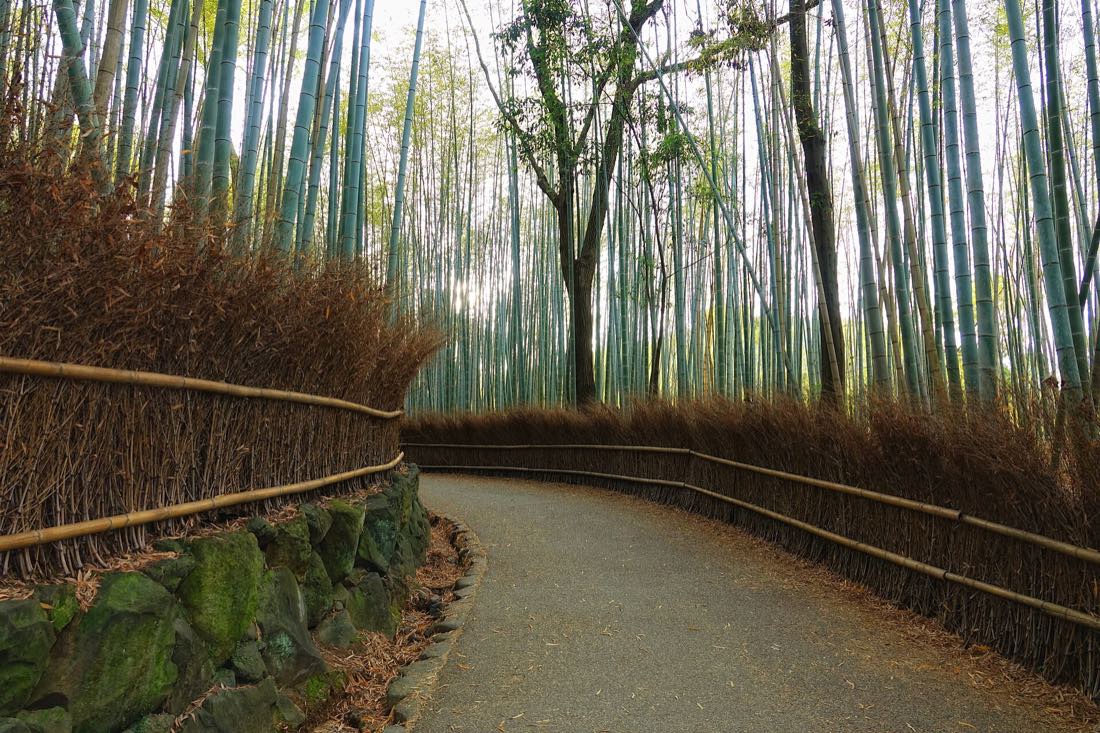
Is the bamboo grove
worth it?
Be honest with yourself about what this is: a five-minute walk down a paved corridor with bamboo on both sides, not a forest you wander through. It is free, it never closes, and before 8:30 in soft light with nobody in it, it is genuinely beautiful. At noon it is a queue of people photographing each other, with rickshaws sharing the same path, and it is the most reliable Instagram-versus-reality letdown in Japan. Go early or do not bother — and either way, walk 50 metres further to Okochi Sanso, which is better and almost empty.
What hour to go
The path is public, unfenced and unlit, with no gate and no ticket, which means the only variable is what time you stand in it. Nothing else about this sight changes.
The practical sweet spot: light, trains running, coffee opening, and maybe thirty people on the whole path.
What the bamboo grove actually is
A paved public footpath, roughly 400 metres of it photogenic, running between two walled temple properties. It takes five minutes to walk end to end. There is no ticket, no entrance, no viewpoint and nowhere to sit.
That is the whole thing, and knowing it in advance is the difference between delight and irritation. The photographs you have seen are shot from ground level with a wide lens at 6:00 in the morning, which compresses the corridor and removes every human being from it. What you get at 11:00 is the same corridor with two hundred people in it and a rickshaw trying to pass.
Rickshaws use the same path. They are not an intrusion on the grove, they are a licensed part of it — riders get access to a stretch closed to general foot traffic and the runners stop at the spots with the best framing. If you cannot beat them, riding one is a legitimate answer.
In November 2025 Japanese media reported tourists carving names and initials into the bamboo stalks. The damage is visible in the lower sections and it does not grow out — a bamboo culm keeps its scars for life. Do not touch the stalks, and do not lean on them for photographs.
The routing hack nobody uses: enter through Tenryu-ji (¥500 garden, opens 8:30) and leave by the temple's north gate. That drops you into the quieter northern end of the grove, walking against the flow of everyone who came up from the station, and it is the single best thing you can do for your experience short of arriving at 7:00.
Treat the grove as one stop inside a half-day rather than a destination in itself. The Arashiyama guide has the full routing, and the monkey park verdict covers the other half of the morning.
The grove month by month
Bamboo is evergreen, so unlike every other sight in Kyoto the grove looks essentially the same in January and July. What changes is the light, the temperature and — decisively — how many people are standing in it.
The scoring here is almost entirely a crowd score. February is the emptiest month of the year in Arashiyama and the grove is exactly as green then as it is in April.
Three Arashiyama sights that beat the grove
- 01
Okochi Sanso Villa — the best ¥1,000 in Arashiyama
A silent-film star's hillside garden at the far end of the bamboo path. The ticket includes matcha and a sweet in the teahouse. It sits fifty metres from the most crowded footpath in western Japan and is routinely near-empty, with a proper view back over the city. If you do one paid thing in Arashiyama, do this.
- 02
Gio-ji — a moss garden the size of a room
A thatched hut and a floor of moss under maples, twenty minutes' walk north into the Sagano back lanes. ¥300, tiny, and quiet even in November. The walk to it — through a village street of old machiya — is half the point.
- 03
Otagi Nenbutsu-ji — 1,200 mossy rakan statues
Twelve hundred small stone disciples carved by amateurs in the 1980s, now furred with moss, each one different and many of them frankly comic — one holds a tennis racket. It is at the top of the Sagano road and almost nobody makes the walk. The best hour in Arashiyama and the least visited.
Is the bamboo grove for you?
The practical bit
What is actually worth paying for in Arashiyama
The grove is free and always will be. Every worthwhile purchase in Arashiyama is about the district around it — the river, the hills and the mountain railway — not the footpath.
Bamboo grove FAQ
Is the Arashiyama bamboo grove overrated?
At 11:00, completely — it is a five-minute paved corridor with several hundred people in it, and that is where every disappointed review comes from. At 7:00 it is quiet, green and genuinely lovely. The sight did not change; the hour did. Nothing on this site is more timing-dependent.
What time should I go to the bamboo forest?
Before 8:30, and ideally 7:00. The first JR trains from Kyoto Station get you there around 6:30 for ¥240. After 8:30 Tenryu-ji opens and the first coaches arrive, and by 10:00 it is a slow-moving line. The 17:00 to 18:00 slot is a quiet second-best that almost nobody uses.
How long is the bamboo grove walk?
The photogenic section is roughly 400 metres and takes about five minutes end to end. There is no loop, no viewpoint and nowhere to sit. Budget 15 minutes if you are stopping for pictures, and plan the rest of your Arashiyama half-day around Tenryu-ji, Okochi Sanso and the river.
Is the bamboo grove free?
Yes — free, unfenced and open 24 hours a day. There is no ticket for it and never has been. Tenryu-ji next door charges ¥500 for the garden and ¥300 more for the buildings, and Okochi Sanso at the far end is ¥1,000 including matcha.
Is it worth going to Arashiyama just for the bamboo?
No. A 15-minute train ride each way for a five-minute path is a bad trade on its own. It is worth going to Arashiyama for the district — Tenryu-ji's 700-year-old pond garden, Okochi Sanso, the monkey park, the Togetsukyo bridge and the Sagano back lanes — with the grove as one stop inside that.
Can you visit the bamboo grove at night?
You can walk it, but there is no lighting and nothing to see. The Arashiyama Hanatoro illumination festival that older guides describe was discontinued after December 2021 and has not returned. Anyone still listing it is working from stale information.
What is the best thing to do near the bamboo grove?
Okochi Sanso Villa, fifty metres from the northern end. ¥1,000 including matcha and a sweet, a hillside garden with a real view, and consistently near-empty while the path outside is packed. Gio-ji (¥300) and Otagi Nenbutsu-ji (¥500) further up the Sagano road are the quieter follow-ups.