Is the Arashiyama
Monkey Park
worth it?
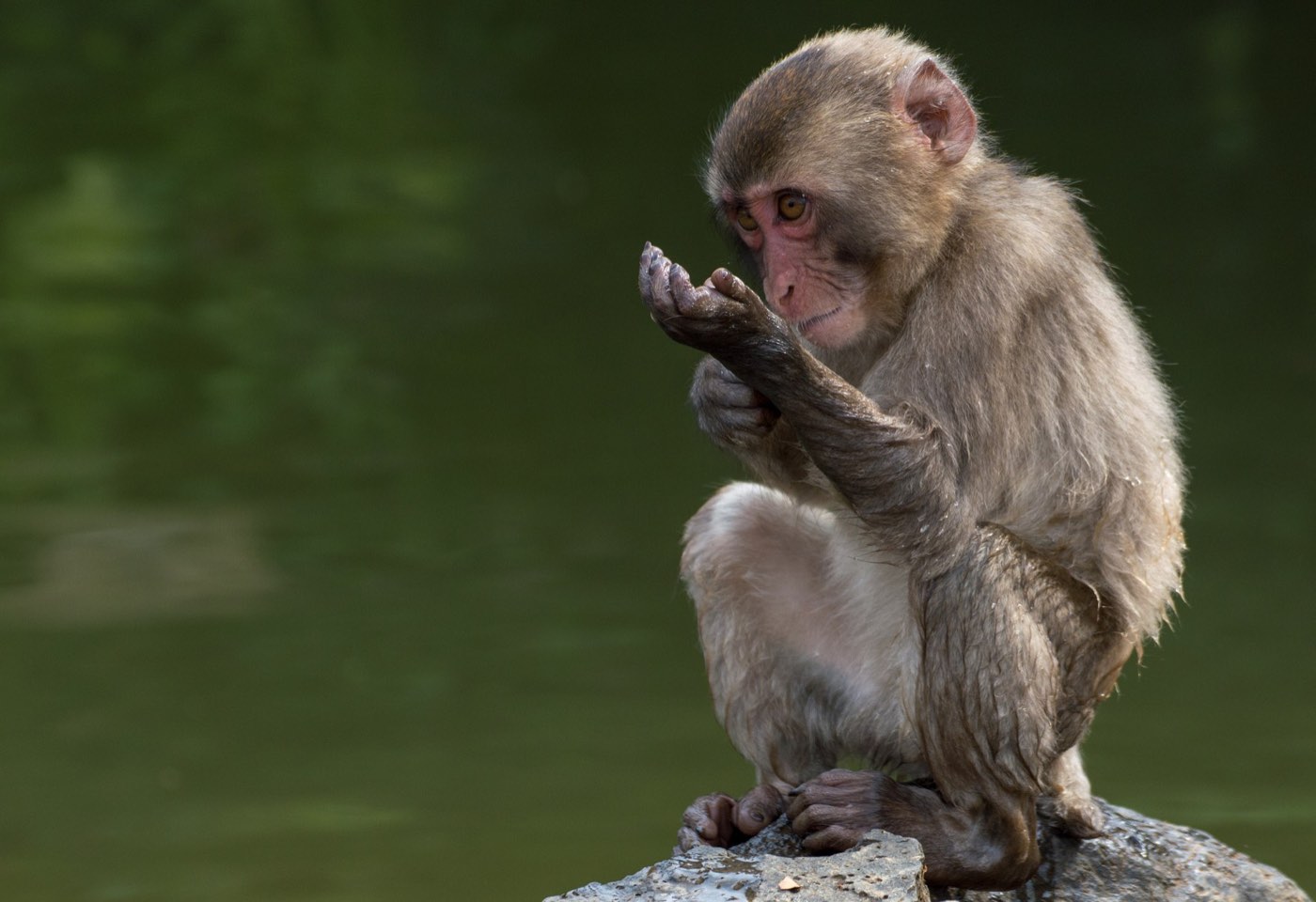
¥800, cash only, and a genuinely steep 20-minute climb that nobody warns you about properly — this is a hill, not a stroll, and in August it is brutal. At the top, around 120 wild Japanese macaques roam a hillside clearing, and the feeding arrangement is inverted: the humans go inside a mesh hut and hand fruit out to the free-roaming animals for ¥100. Behind it is the finest open view over Kyoto you can get without paying for a tower. With children it is the best thing in Arashiyama. Without them, it is still the best view.
What hour to go
The climb self-selects, so this is never the crush that the bamboo grove is fifteen minutes away. What matters more here is heat and light: in summer, go at opening or not at all.
Opens 9:00. Cool, quiet and the monkeys are active. In July and August this is the only civilised hour to do the climb.
What to expect at the monkey park
A twenty-minute uphill walk on a stepped and switchbacked path, then a clearing on the shoulder of Iwatayama with a hundred-odd macaques living their lives around you, and a view straight down the Kyoto basin.
The climb is real. It is roughly 20 minutes, continuously uphill, on steps and a dirt path. People with knee problems, small children on foot, or a summer afternoon behind them find it genuinely hard, and there is no shuttle and no alternative route. Bring water. If that rules it out, the Togetsukyo bridge and the riverbank below are free and lovely.
The animals are wild. This is the point reviews get wrong in both directions. The macaques are not captive, not fenced and not fed on demand — they live on the mountain and come and go as they please. What is caged is you: the feeding hut is a mesh-walled shelter that humans stand inside, buying ¥100 bags of apple or banana and passing pieces out through the wire. It is the correct way round, and it exists so that nobody is grabbed.
The view is the underrated half of the ticket. From the clearing you look down the whole Kyoto basin — the river, the grid of the city, the eastern hills behind it. It beats the view from Kyoto Tower, which costs around ¥900, and it beats anything at Kiyomizu.
Ninety minutes covers it comfortably: twenty up, forty at the top, twenty down, and a few minutes queueing for fruit. There is a small building with information about the troop and its hierarchy, which is more interesting than it sounds — the monkeys are individually named and ranked.
How to behave around the macaques
These are not decorative signs. The troop is habituated to people but entirely wild, and every incident reported here comes from a visitor breaking one of these four.
A direct stare is a threat display in macaque. Holding eye contact is the most common way visitors provoke a lunge. Look near them, not at them, and do not push a phone lens straight into a face at close range.
No stroking, no reaching out, no posing with one. They are wild animals with teeth, and a bite means a hospital trip and a rabies-protocol conversation you do not want to have on holiday.
Food must stay out of sight and inside a closed bag before you reach the summit. A visible snack, an open bottle or a dangling shopping bag will be taken. Feeding is only permitted from inside the hut, with the ¥100 fruit sold there.
Sunglasses on your head, a phone held out at arm's length and unzipped bags all go missing. Keep your bag closed and your phone in your hand rather than extended toward an animal.
Is the monkey park for you?
The practical bit
Building a day around Arashiyama
The park itself takes cash at a hut at the top of a hill — there is nothing to pre-book and no queue to skip. What is worth buying is the rest of the district: the river, the gorge and the hot spring at the end of the day.
Arashiyama Monkey Park FAQ
How hard is the climb to the monkey park?
Harder than most guides admit. It is a continuous 20-minute uphill on steps and a dirt path, with no shuttle, no lift and no step-free alternative. Fit adults find it easy, and anyone with knee trouble, a pushchair or a July afternoon behind them finds it genuinely tough. Bring water.
Are the monkeys in cages?
No — the humans are. The roughly 120 Japanese macaques are wild and roam the mountain freely, and the feeding hut is a mesh-walled shelter that visitors stand inside, passing ¥100 bags of fruit out through the wire. It is set up that way so nobody gets grabbed, and it works.
How much is the Arashiyama Monkey Park?
¥800 for adults and around ¥400 for children, cash only — there is no card machine at the top of a hill. A rise to ¥1,000 has been rumoured but we could not confirm it as of August 2026, so carry a little extra. Fruit for feeding is ¥100 a bag on top.
Is the monkey park safe for children?
Yes, with the rules followed: no eye contact, no touching, no visible food, and bags kept closed. Children love it, and the feeding hut puts a physical barrier between them and the animals. The real risk is the climb rather than the macaques — factor in 20 minutes uphill each way.
Is the view from the monkey park worth it on its own?
It is the best open panorama over Kyoto that does not cost around ¥900 for a tower ticket — the river, the city grid and the eastern hills, straight down the basin. Plenty of people come for the monkeys and remember the view. Late afternoon light is the best of it.
Can I combine the monkey park with the bamboo grove?
Yes, and it is the standard Arashiyama half-day. Grove at 7:00 while it is empty, Tenryu-ji at 8:30, then over the Togetsukyo bridge to the monkey park at opening. See the bamboo grove verdict for why the order matters that much.
What time does the monkey park close?
Around 16:30, with last entry roughly 16:00, and shorter hours in winter. Since the climb takes 20 minutes, arriving at 15:50 gets you very little. Go at 9:00 instead, especially in summer — the hill in the afternoon heat is the part people regret.