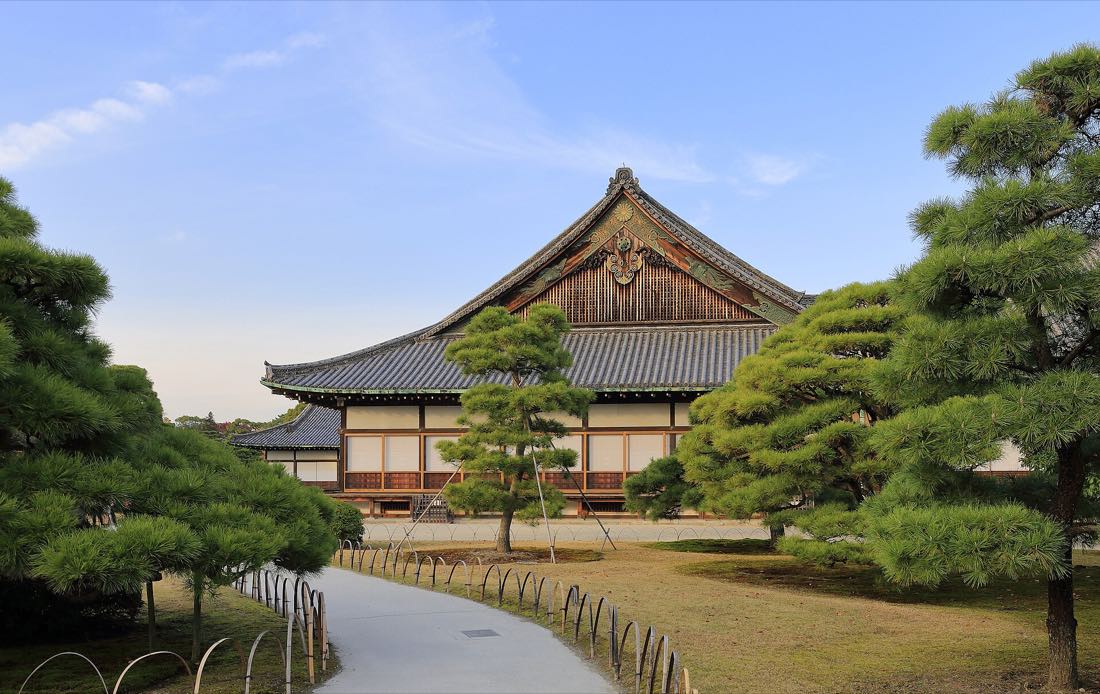
Is Nijo Castle
worth it?
Nijo Castle is the one major Kyoto sight where you actually walk inside the historic building, and that is the entire case for it. Pay the ¥1,300 with Ninomaru Palace — the ¥800 grounds-only ticket misses the point completely. Inside are 33 rooms of Kano-school painted screens, floors built to squeak underfoot as an intruder alarm, and the audience chamber where the last shogun handed power back to the emperor in 1867. It is also the best-connected major sight in the city: the Tozai subway surfaces at the gate. Ninety minutes, and a strong rainy-day and step-free option.
What hour to go
The grounds run to 275,000 square metres, so crowds barely register outside. The pinch point is Ninomaru Palace itself — a single-file one-way route through 33 rooms in stockinged feet, and it can back up badly.
Quiet. The best hour for the palace interior — you can stop at each room instead of being shuffled along.
Which Nijo Castle ticket to buy
Two tiers, and the cheaper one is a trap for anyone who came for the history rather than a walk in a park.
| Ticket | Price | What you get | Verdict |
|---|---|---|---|
| Grounds only | ¥800 | Outer walls, the Ninomaru garden, Seiryu-en, the Honmaru area and the stone keep base | SKIP |
| Grounds + Ninomaru Palace | ¥1,300 | All of the above plus the 33-room palace interior, the nightingale floors and the 1867 audience chamber | WORTH IT |
| NAKED projection-mapping night | ~¥2,000–3,000 | Seasonal evening event — the castle lit and projected onto. Separate ticket, sold online, dates vary each year | DEPENDS |
The ¥500 difference buys the only shogunal palace interior open to the public in Kyoto. If you are going to skip the palace, skip the castle and spend the morning at Sanjusangendo instead.
What to expect at Nijo Castle
Ninety minutes: forty of them walking a one-way route in your socks through the palace, the rest in gardens that are pleasant rather than exceptional.
The nightingale floors. The corridors of Ninomaru Palace were built so the floorboards chirp against their nails as you walk — an intruder alarm you cannot switch off. Two hundred people walking it at once produces a continuous birdsong that is, unexpectedly, the thing most visitors describe afterwards.
The Kano-school screens. Tigers, leopards, pines and cranes across sliding doors, arranged as pure political theatre: the rooms escalate in intimidation the closer a visitor got to the shogun. The originals are being progressively moved to the on-site gallery and replaced in situ with reproductions — which is conservation, not a con, but worth knowing.
The room where it ended. In the Ohiroma great chamber in 1867, Tokugawa Yoshinobu announced the return of power to the emperor, closing 265 years of shogunal rule. Standing in it is the closest thing Kyoto offers to a specific historical moment with an address.
The gardens are fine. Ninomaru's is a proper Momoyama-period stroll garden with a pond and enormous stones; Seiryu-en at the back is 1960s and mostly empty. Nobody comes to Nijo for the gardens, and if that is what you want, Ginkaku-ji costs ¥500 and does it better.
Photography is not permitted inside Ninomaru Palace. As at Sanjusangendo, this is part of why it stays civil.
Is Nijo Castle for you?
The practical bit
Guided options at Nijo
You can walk up and pay ¥1,300 in cash any day the castle is open. A guide is worth it here in a way it is not at most temples: the painted screens are a political argument, and without someone to read them they are decorative wallpaper. Temple gates take cash at the door and never sell out — a tour is worth paying for because of the guiding and the hour, not to skip a queue that does not exist.
Nijo Castle FAQ
Is Nijo Castle worth the ¥1,300?
Yes, if you buy the ticket with Ninomaru Palace. It is the only shogunal palace interior open to the public in Kyoto, and the ¥800 grounds-only ticket leaves you walking around a large empty park. If ¥1,300 is too much, spend ¥600 at Sanjusangendo instead — it is the better ticket at half the price.
What are the nightingale floors at Nijo Castle?
Corridor floorboards built so the nails rub against clamps underneath and chirp when anyone walks on them — a deliberate intruder alarm protecting the shogun. You cannot cross them silently no matter how carefully you tread, and with a full corridor of visitors the effect is continuous.
Is Nijo Castle closed on Tuesdays?
Some Tuesdays, not all — the closure schedule rotates by month, and there are additional closures from 29 December to 3 January. This is one of the most common wasted journeys in Kyoto. Check the official castle site for the current month before you set out.
How do I get to Nijo Castle?
Tozai subway line to Nijojo-mae. The castle gate is directly outside the exit, which makes this the easiest major sight in Kyoto to reach — no bus, no hill, no 20-minute walk. From Kyoto Station, take the Karasuma line to Karasuma-Oike and change to the Tozai.
Is Nijo Castle good in the rain?
One of the best options in the city. Ninomaru Palace is a 40-minute indoor walk, the route is covered and the floors are dry. Combine it with Sanjusangendo and teamLab Biovortex and you have a full wet day handled — see the rainy-day guide.
Is Nijo Castle wheelchair accessible?
Better than any other headline sight in Kyoto. The grounds are flat and paved, and Ninomaru Palace has a ramped visitor route rather than the steps you find at hillside temples. Kiyomizu-dera and Fushimi Inari are the difficult ones; this is the easy one.
What is the Nijo Castle projection mapping event?
A seasonal evening installation run by the NAKED studio — the castle walls and gardens lit and projected onto after dark, typically around ¥2,000 to ¥3,000 and ticketed separately online. Dates change every year, so treat it as a bonus if it coincides with your trip rather than a fixed plan.